






If you have just fallen at a Las Vegas hotel, casino, or store, you may have one chance to capture the evidence that will decide your case—and a very short window to do it. The condition that injured you is often cleaned up or repaired within hours. Once it is gone, it is gone, and proving what was there becomes far harder.
So before you leave the property, and before anyone tidies the scene, take out your phone. Here is exactly what to capture and why each piece matters.
Why Photographs Decide These Cases
Most premises injury cases turn on a single question: did the property know, or should it have known, about the hazard in time to fix it? Your photographs and videos are often the best proof of what the hazard actually was and how it came to be there.
They also close off the property’s most reliable defense. It is common for a business to later describe a hazard as trivial—a very small drop of water, a barely noticeable ridge in the carpet—especially after it has cleaned the area up without documenting anything itself. A clear photograph or video taken before the cleanup answers that account with something a jury can see for itself. Without it, these cases often come down to your word against the property’s, and people carry an instinctive assumption that anyone who falls simply should have watched their step. Photographs are what overcome that assumption.
The Shot List
Capture more than you think you need. It is far better to have a photo you never use than to wish you had one that no longer exists.
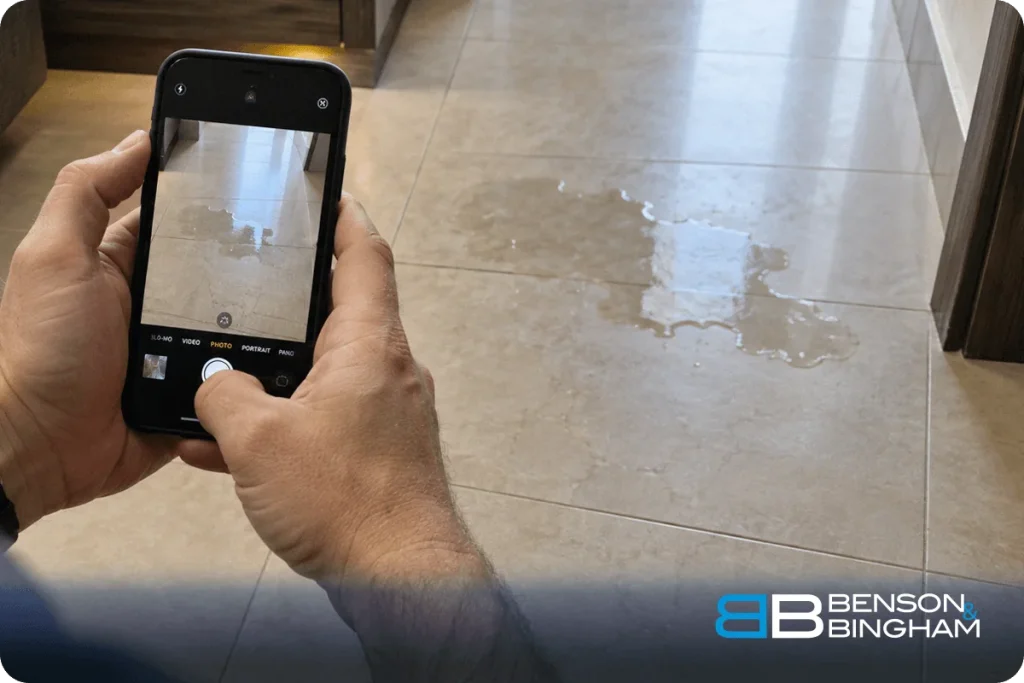
- The hazard itself, up close. The spilled liquid, the torn or bunched carpet, the broken tile, the uneven lip where one surface meets another. Get close enough to show its size, its edges, and its texture.
- The same hazard from standing height. A wide shot from where you were walking shows what the condition looked like to an approaching person—and how hard or easy it was to see.
- The whole area around it. Several steps back, from a few angles, so the location and its surroundings are clear.
- The absence of any warning. If there was no wet-floor sign, no cone, or no barrier, photograph the area in a way that shows nothing was there to warn you. Their absence is often the heart of the case.
- What caused it, if you can see it. A leaking cooler or ice machine, an overflowing drain, a dripping pipe, or a spill with no attendant nearby. The source helps show how long the hazard was likely present.
- The lighting. If poor lighting hid the danger, capture how dim the area actually was.
- Your injuries—right away and over the days that follow. Bruising, swelling, and cuts change quickly. Photograph them immediately and keep photographing as they develop.
- Your clothing and shoes. Wet or stained clothing where you landed helps show the fall and the substance involved. A clear shot of the shoes you were wearing can rebut a later claim that unsafe footwear was to blame.
- Anything that fixes the location and time. Store signage, a room or area number, or a nearby landmark. Leave the timestamp and location data on your phone’s photos turned on; that information can matter later.

If you can, take video as well—a slow pan across the scene captures context and scale that still photos miss.
Take as many photographs as you can. If you are in too much pain to do it yourself, ask a spouse or a friend to photograph the scene—and to photograph you where you are, on the floor, if you are still sitting or lying there. Capture the moment. There is no such thing as too many photographs.
Get the Witnesses Before They Scatter
The couple visiting from another state who saw you fall will be gone tomorrow. A name and a phone number or email for anyone who saw what happened, or who saw the hazard before you did, can be worth more than almost anything else you collect. If a witness is willing, ask them to send you their own photos too.
Photographs Are Only Half of It—Reporting Is the Other Half
Capturing the scene protects the evidence you can see. Reporting the incident protects the evidence you cannot—the property’s surveillance footage, maintenance logs, and inspection records—because a property’s obligation to preserve those materials generally depends on its being put on notice that something happened. Our companion articles, “What Actually Happens After You File an Incident Report,” explain that step, and “Why Hotel Surveillance Footage Disappears Within About Thirty Days” explains why it cannot wait.
What if You Already Left or Didn’t Take Photos?
It is not necessarily too late, but it does raise the stakes on everything else. The footage and records held by the property may still exist on longer-retention cycles — for now — and the sooner a demand goes out to preserve them, the better. When our firm is retained, we can often get a formal preservation letter to the property within twenty-four hours. If you have already gone home and are only now realizing your injury is serious, the most useful thing you can do is start that process quickly.
For the full picture of how a visitor’s claim works, start with our overview: Out-of-State Clients—Injured in Nevada While Visiting From Out of State?