






Filing an incident report is one of the most important things you can do after being hurt at a Las Vegas hotel or casino and one of the least understood. People often picture it as paperwork that disappears into a drawer. It is closer to the opposite: it sets several things in motion at once, some of which help you and some of which are designed to help the property. Knowing what actually happens lets you do it right.
Why the Report Matters More Than It Looks
A property’s legal responsibility for your injury usually turns on notice—whether it knew, or should have known, about the dangerous condition and failed to address it. Filing a report is what puts the property formally on notice that an incident occurred.
That matters for a reason most visitors never learn until it is too late. Much of the evidence that would prove your case—surveillance footage, maintenance logs, inspection and cleaning records—is held by the property and is subject to routine destruction. Footage in particular is often overwritten within about thirty days. A property’s obligation to hold on to that evidence, rather than let it cycle away on schedule, generally depends on its having been notified that a claim may follow.
In other words, the report is not just a record of what happened. It is the thing that starts the clock on the property’s duty to preserve the proof.
Where the Report Actually Goes
It does not sit with the front desk or security employee who wrote it down. Once filed, an incident report is typically routed to the property’s risk-management or claims department, a function these large properties staff specifically to handle guest injuries. From there it may trigger the property’s own investigation, notice to its insurer, and, often quickly, an outreach call to you.
A property’s risk-management department is usually in-house, and it can begin evaluating the property’s exposure to liability immediately and begin taking steps to minimize it. Often a representative will come to the scene to document anything you may have done wrong in order to reduce the property’s share of the blame.
That early call can feel like customer service. It is worth understanding that it is also information-gathering and that anything you say may shape how your claim is evaluated. Our article on whether to give a recorded statement to the property’s insurer covers that conversation in detail; the short version is that you are not required to give a recorded statement before you understand your own claim.
What the Form Does — and Does Not — Capture
An incident report is drafted by the property, on the property’s form, and it is not a neutral record. It captures some things well: that an incident occurred, roughly when and where, and that you were involved. It captures other things poorly, or not at all and sometimes in language that quietly favors the property.
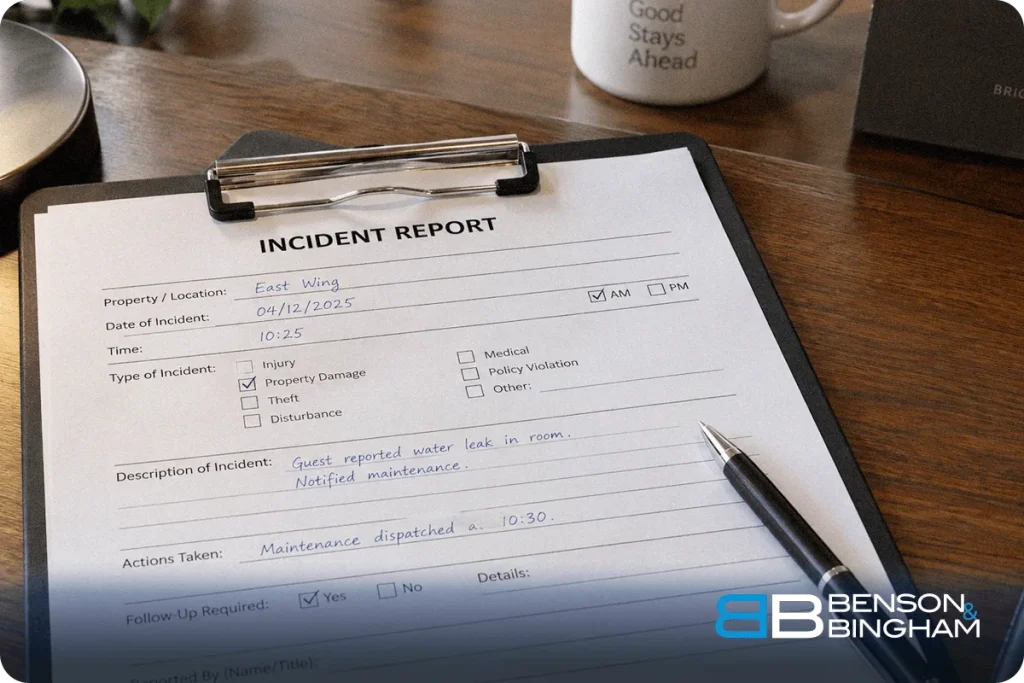
This is the same dynamic that decides so many premises cases. A property will often characterize a hazard as trivial after the fact — a very small drop of water, a barely noticeable ridge—particularly once it has cleaned the area without documenting it. If the report’s description of the condition is vague or minimizing, that wording can be used later. You are not obligated to adopt the property’s characterization of what happened.
Often, security personnel or risk management will record that you were “not sure” what caused you to fall. Many people say exactly that in the moment, because it is honest, a hidden danger is, by definition, hidden, and security is on the scene before you have had any chance to look. But once you are back on your feet and can actually examine the area, you may see plainly what caused it: the uneven surface, the spilled liquid, or the debris on the floor. The report, written in those first moments, may never mention the hidden condition that actually brought you down, leaving only your early “not sure” on the record.
Should You Sign It?
Reporting the incident is important. Signing a document you have not read is not the same thing. A few practical points:
- Read what you are signing. Make sure the description of the condition and the incident is accurate and complete before you put your name to it. If it minimizes the hazard or suggests the fall was your fault, you do not have to accept that wording.
- Reporting and admitting fault are different. You can report exactly what happened without agreeing to the property’s version of why.
- Watch for anything that looks like a release. A form that accompanies an offer—a comped stay, a voucher, a promise to cover a bill—can carry a release of your claims. Do not sign a release, and have any such document reviewed first.
What to Take With You
Before you leave the desk, get the report number and the name of the person who took it. Ask for a copy; you may not be given one on the spot, but ask, and note who you asked. That number is how the documented existence of your claim gets confirmed later, even if the property is slow to produce the report itself.
Who Actually Receives Your Claim May Not Be Who You Think
The name on the building is frequently not the entity that owns it, which is frequently not the entity that operates it, which may not be the entity that employed the person involved. Resort properties commonly separate ownership, operation, and the third-party companies that run specific pools, clubs, restaurants, and venues inside them. The incident report you file may be handled by, or ultimately concern, an entity you have never heard of, and naming the correct one is part of what determines whether a claim succeeds. Our article on who actually owns the hotel where you were hurt explains why that matters.
If You Didn’t File a Report, or Already Went Home
It is not necessarily too late, but move quickly. You can still document what you remember, gather any photos or witness information you have, and most importantly, get a demand to the property to preserve its footage and records before they are overwritten. When our firm is retained, we can often send that preservation letter within twenty-four hours. If you are only now realizing your injury is serious, the sooner that happens, the more of the proof survives.
For the full picture of how a visitor’s claim works, start with our overview: Injured While Visiting Las Vegas: What Out-of-State Visitors Need to Know.