






Las Vegas is the undisputed convention capital of the country. In a given week, tens of thousands of business travelers fill the Las Vegas Convention Center, Mandalay Bay, the Venetian Expo, Caesars Forum, and the big hotel ballrooms for trade shows such as CES that turn an empty hall into a temporary city—and then tear it down days later.
If you were hurt at one of those shows, you may have already encountered what makes these cases different from an ordinary slip on a casino floor: a convention is not run by one company. It is built by many, and a tough question in your case may be knowing which one is responsible.
The venue, show organizer, general services contractor, exhibitor, or a specialized vendor may be the responsible party, depending on who created the hazard, controlled the area, or failed to take reasonable safety precautions. (Pro Tip: More than one party may share the liability!)
Benson & Bingham Injury Law represents people injured at Las Vegas conventions and trade shows. Here is why responsibility can get tangled at these events and how it gets sorted out.
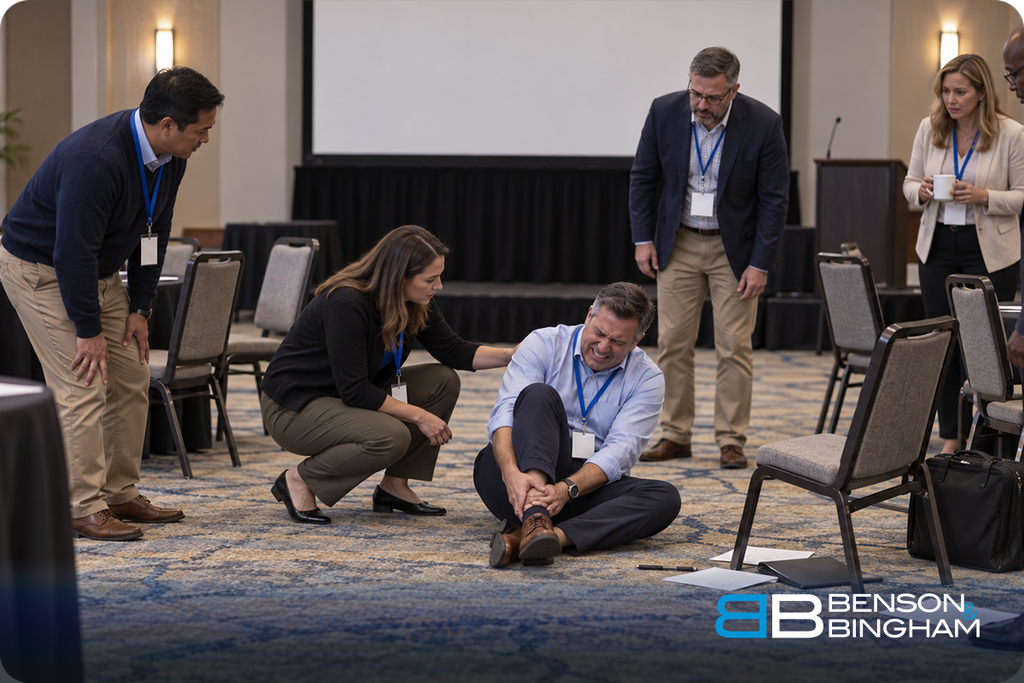
How People Get Hurt at Conventions and Trade Shows
Temporary flooring, displays, equipment, furnishings, and crowds can all create hazards during the show as well as during setup or teardown. Serious injuries can quickly result from:
- Trips and falls on the show floor—cables and cords, seams and edges of temporary flooring, loose or bunched aisle carpet, and uneven transitions.
- Falling displays and structures—booth walls, signage, hanging banners, rigging, shelving, and product displays that were poorly built or anchored.
- Material-handling and move-in/move-out incidents—forklifts, pallet jacks, and heavy freight moving through the hall during setup and teardown.
- Booth and equipment incidents—demonstration machinery, product samples, electrical equipment, and booth structures.
- Crowd-related incidents—packed aisles, overcrowding, bottlenecks, and crowd surges at popular booths or product reveals.
Each can involve a different responsible party. The type of accident is a starting point; the investigation must establish what actually happened.
Who May Be Responsible for a Convention Injury?
When you fall on a show floor, it can feel obvious who is responsible: the place where it happened. But “the place” involves several separate companies, each handling a different part of the event:
- The venue—the convention center or hotel owner or operator, whose responsibilities may include building conditions and areas that fall under its control.
- The show organizer or management company—the entity that produces the event and coordinates the overall floor plan and event rules.
- The general services contractor, sometimes called the “decorator”—the company hired to provide services such as aisle carpet, pipe-and-drape, freight handling, running and covering cabling, and other elements of the show build-out.
- The exhibitor—the company whose booth, display, equipment, or product was involved in the incident.
- Labor, rigging, electrical, and equipment companies—specialized vendors or subcontractors that install structures, supply equipment, or perform particular work.
Any one of them—or several at once—may bear responsibility for your injury. A cable hazard, for example, might involve the company that installed it, the exhibitor using it, or a party responsible for inspecting it. The answer depends on the actual work, control, and duties involved.
Naming the wrong party can even negatively impact your case. Identifying every potentially responsible party matters. Overlooking even one can complicate your claim or leave a source of recovery potentially unexplored.
Why Event Contracts and Insurance Matter
Before the show opened, the companies involved signed agreements allocating their work and responsibilities. Those agreements may contain indemnity clauses—provisions requiring one party to cover certain losses or legal costs incurred by another.
These clauses do not automatically establish who was negligent or erase an injured attendee’s rights. Their effect depends on the wording, applicable law, and circumstances of the injury. However, they can affect how the companies allocate costs and which insurance policies may respond.
These same companies often point fingers at each other, each insisting another party is responsible under the agreements, which can stall a claim that is not handled by someone who knows how to evaluate and cut through it.
Our investigation begins by identifying who designed, built, installed, maintained, inspected, and controlled the specific area or condition that caused the injury. Depending on the case, relevant records may include:
- Venue, exhibitor, show-management, and contractor agreements
- Vendor and subcontractor agreements, work orders, and invoices
- Insurance policies, endorsements, and certificates of insurance
- Incident reports, inspection records, floor plans, and build or freight schedules
We seek preservation of relevant records and pursue access through direct requests where available and, when necessary, formal discovery or subpoenas through the legal process. A preservation demand requests that evidence be kept; it does not by itself compel a company to hand over requested documents.
We also review indemnity and insurance provisions, including any requirement to name another participant as an additional insured. That means a party may have coverage under another company’s policy, subject to the policy’s terms. A certificate of insurance alone does not establish the full scope of coverage. Those clauses do not necessarily decide who was negligent, but they can reveal how the parties allocated responsibility—and identify additional insurance coverage that might otherwise be overlooked.
By comparing the contractual responsibilities with what actually happened on the show floor, we can investigate who created the dangerous condition, who controlled it, who had a duty to inspect or correct it, and which companies and insurance policies may be involved.
What Nevada Law Requires
For a claim involving an unsafe floor or other property condition, the central question is whether a responsible party failed to use reasonable care and if that failure caused your injury. Relevant questions include who created the hazard, who controlled the area, and whether a party knew—or should have known—about the condition in time to address it.
Contracts and floor plans help answer those questions, but they are only part of the evidence. Inspection practices, witness accounts, photographs, and the parties’ actual conduct will also matter greatly. An injury involving defective equipment or a product may raise additional legal issues.
If someone argues that you should have seen a cable or simply avoided a hazard, that does automatically end a negligence claim. Under Nevada’s comparative negligence rule, NRS 41.141, you can generally recover damages if your share of fault is no greater than the combined fault of the defendants against whom recovery is sought. Your damages are then reduced by your percentage of fault; if your fault exceeds that threshold, recovery is barred.
For many Nevada personal injury lawsuits, NRS 11.190(4)(e) generally provides a two-year filing period, often measured starting from the injury date. Exceptions and other deadlines may apply. Evidence may be lost much sooner, so the filing period should not be treated as any justifiable reason to wait.
If you were attending or working at the show as part of your job, workers’ compensation may also be relevant to your case. A claim against a responsible third party may be possible, but employment relationships, applicable state law, and workers’ compensation rules can all affect your options. In this case, notify your employer promptly and ask about deadlines that may apply to your specific situation.
Why Acting Quickly Is Crucial for Out-Of-State Attendees
You came for a two-day show and flew home. You may not even know which company’s area you were standing in when you fell, let alone who laid the floor or which agreements governed the booth.
The records that answer those questions may be scattered across several companies. Some of those companies packed up and left Las Vegas as soon as the show ended. Surveillance footage may be overwritten, relevant temporary structures dismantled, and witnesses dispersed.
That is why early investigation of the incident is so vitally important. Identifying the companies involved and requesting preservation of relevant evidence can help protect your potential claim. Retention policies vary; there is no single deadline that applies to maintaining event records.
If you are still at the show and can do so safely:
- Get medical attention quickly and report the injury to venue security or show management. Ask for the incident report number and how to request a copy.
- Document the exact location and conditions. Photograph the hazard, nearby booth names or numbers for context, and surrounding areas without putting yourself at risk.
- Save identifying details. Keep your badge, event information, witness contact details, and any messages you may have about or related to the incident.
If you have already returned home, write down as much as you can remember and store your photographs, medical records, and correspondence. You do not need to identify the responsible company or party by yourself before asking an attorney or law firm for legal support.
The ownership and control questions overlap with our article on [who actually owns and operates the property where you were hurt. For how your own conduct may affect the claim, see our guide to Nevada comparative negligence.
Getting Help With a Las Vegas Convention Injury
A convention injury may involve more than the venue where it happened. A useful investigation follows both the physical evidence and the agreements behind the event to identify the responsible parties and available coverage.
Call Benson & Bingham Injury Law at (702) 600-6000 for a free consultation with a skilled attorney. We are available to assist you 24/7. If you have returned home, we provide video and phone consultations that may be more convenient for your situation.
Simply share with us the event or show name, where and when the injury happened, and what you already know about the hazard. We can discuss potential next steps and whether evidence needs prompt attention. You do not need the event contracts—or any complete answers about who is responsible—to reach out and begin the conversation. We’re here and ready to help.
For an even fuller picture of how a visitor’s claim works, see Injured While Visiting Las Vegas: What Out-of-State Visitors Need to Know.