






A night out is part of the Las Vegas experience—the clubs, the bars, the pool parties that run into the evening. It is also where serious injuries can happen: a fall on a dark, wet floor, broken glass on a crowded walkway, or an unexpected encounter with a club’s own security staff.
Nevada generally does not allow a claim simply on a venue serving too much alcohol to an adult. But that does not necessarily shield a nightclub or bar from liability for unlawful force by security, inadequate venue protections, or unsafe conditions.
Benson & Bingham Injury Law represents visitors injured at Las Vegas clubs, bars, stadiums, and lounges. Here is how these claims work—and why having been drinking does not automatically mean you have no case or a weak case.
Can You Sue a Nevada Bar for Overserving Alcohol?
In many states, a bar may be held liable for serving a visibly intoxicated patron who then hurts someone. That is commonly known as dram shop liability.
Nevada takes a different approach. Under NRS 41.1305, a person who serves alcohol to someone 21 or older is generally not civilly liable for harm that person causes as a result of drinking. An allegation that a club “served too much” is therefore not generally enough to support a claim.
That rule makes it important to identify the venue’s conduct beyond serving alcohol. Did security use unlawful force? Did staff ignore a developing confrontation? Was there an unsafe condition the venue should have addressed? Those are separate questions that support different claims.
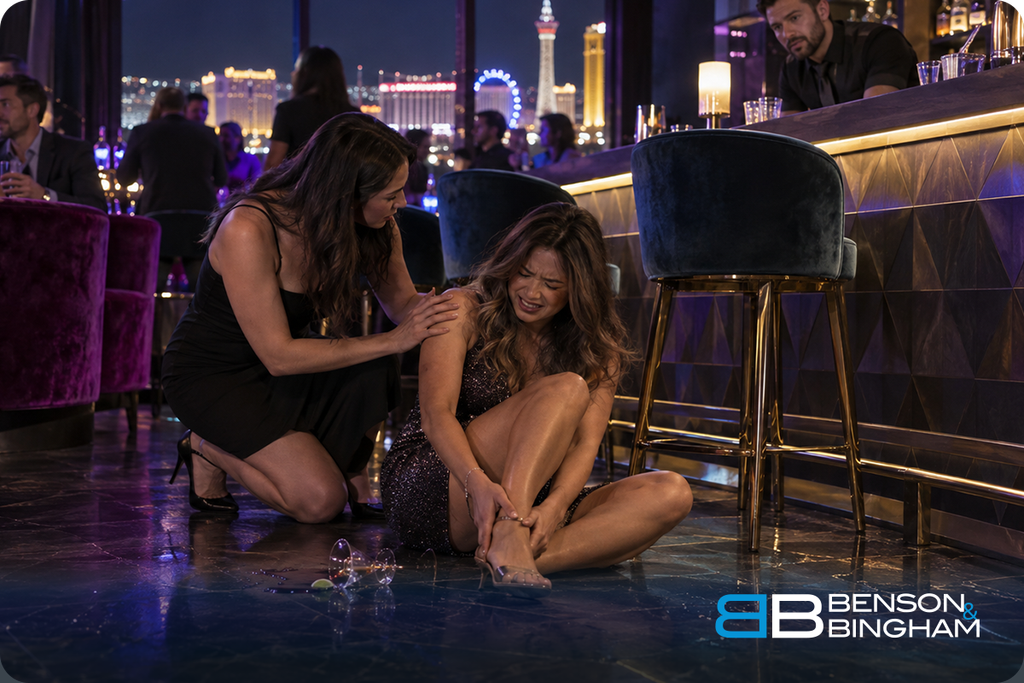
When Nightclub and Bar Injuries Happen
Depending on what happened, a potential claim may involve:
- Excessive force by security. Unnecessary or excessive physical force during a confrontation, restraint, or removal from the premises.
- Inadequate security. A foreseeable assault that the venue failed to take reasonable steps to prevent or address. Prior incidents, staff warnings, and the response to a developing confrontation can be important elements that matter to the case.
- Crowd-control failures. Dangerous overcrowding, bottlenecks, or surges at entrances, exits, and in popular common areas.
- Premises hazards. Wet floors, poorly lit walkways, unmarked steps or level changes, broken glass, and unsafe staging or seating.
- Falls from height. Unsafe stairs, steep balconies, mezzanines, stage areas, venue platforms, or other elevated areas without adequate railing or lighting.
For a premises hazard, premises liability, or unsafe-condition claim, important questions include who created the hazard in the first place, who controlled the safety of the area, and whether a responsible party knew—or should have known—about it in time to respond effectively.
Surveillance, inspection records, prior incident history, maintenance logs, and witness accounts can help establish those facts.
When Nightclub Security Uses Excessive Force
Security may lawfully remove a patron in appropriate circumstances and also use reasonable force when legally justified. However, that authority has its limits.
Striking someone after a threat has ended, using an unjustified chokehold, or continuing to restrain beyond what the circumstances require may support a civil battery claim. Separate failures in hiring, training, or proper supervision may support negligence claims against the responsible venue or company.
Whether force was justified depends on the full context of the encounter: what the patron and guards did, what threat existed, if any, and how security responded. A patron’s intoxication or difficult behavior does not provide security staff with unlimited authority to cause harm.
The guard’s employer may also be liable, depending on assigned duties, the circumstances, and Nevada’s employer liability rules. Liability is not automatic simply because the security staff worked there. That’s why it matters so much to properly document the encounter and employer.
How We Investigate Security-Related Injuries
Training and supervision are important, but the first question is what actually happened. We examine all the details of the encounter alongside applicable policies, the guards’ responsibilities, and any warning signs management had before the injury.
We pursue the reports, training records, and relevant history. Depending on the case, that includes incident and security reports, witness statements, use-of-force policies, training materials, and any relevant personnel or disciplinary records. Prior complaints or similar incidents may also help establish what management knew, but their existence must be investigated rather than assumed.
We seek testimony from the security staff and other witnesses. In litigation, that may include depositions of guards who used force, coworkers who witnessed it, supervisors, or other people directly or indirectly involved. A fellow guard’s account may help establish whether the response followed training, whether a restraint was permitted, or whether the situation could’ve been handled differently.
We compare the force used with what was justified and permitted. We look at the venue’s policies and training alongside the legal limits on use of force. A policy violation can be relevant, but does not by itself resolve liability. We seek out the sequence leading up to the injury, not just a few seconds of the final struggle.
We examine the company’s conduct as well as the guard’s. Who hired, trained, and supervised the security guard? Did management receive prior complaints? Were problems addressed? Was a security contractor involved? These key questions can reveal whether the injury involved an individual act, a preventable company failure, or both.
We have handled many security injury and premises liability cases and know the evidence and testimony to pursue. Access to internal records may require formal discovery or subpoenas; a preservation request alone does not compel their production for review.
Can Punitive Damages Apply to a Security Assault?
Punitive damages are intended to punish and deter certain serious misconduct, beyond just compensating an injured person for their losses. Under NRS 42.005, they require clear and convincing evidence of oppression, fraud, or malice. Excessive force may warrant that analysis, but an injury alone does not establish entitlement.
NRS 42.007 adds requirements when punitive damages are sought from an employer for an employee’s conduct. These include advance knowledge of unfitness, coupled with conscious disregard, authorization or endorsement of the wrongful act, or the employer’s own oppression, fraud, or malice. For a corporate employer, qualifying involvement by an officer, director, or managing agent is required.
Nevada generally caps punitive damages at three times compensatory damages when those damages are $100,000 or more, or $300,000 when compensatory damages are below $100,000, subject to statutory exceptions. Availability and amount depend on the evidence and applicable law. Even capped, the possibility of punitive damages changes how seriously a nightclub and its insurer treat a security abuse claim.
Who May Be Responsible for a Nightclub or Bar Injury?
The club may not be operated by the hotel whose name is on the building. A separate hospitality group may run the venue, and another company may provide security.
Depending on their roles and conduct, potentially responsible parties may include the individual guard, the venue operator, the security company, or the property owner. The hotel’s name or ownership alone does not establish liability.
Identifying the right parties is early investigative work. Our article on who actually owns and operates the property where you were hurt explains that issue. For pool parties and dayclubs, see injured at a Las Vegas pool or dayclub.
Can You Still Have a Claim if You Had Been Drinking?
Yes. Drinking alcohol does not automatically disqualify you from bringing forth an injury claim. What matters is how the incident happened, what unfolded, and which legal claims apply.
For negligence claims, NRS 41.141 generally permits recovery when your share of fault is no greater than the combined fault of the defendants against whom recovery is sought. That means damages are reduced by your percentage of fault; exceeding that threshold bars recovery.
An intentional battery claim involves different rules. Your actions may still matter to questions such as self-defense or whether force was justified, but drinking alone does not excuse unlawful force. Our guide to Nevada comparative negligence explains shared fault in negligence claims.
Protecting Evidence After You Return Home
A visitor may leave Las Vegas before knowing who employed the guard or whether the incident was captured on video. Meanwhile, footage may be overwritten and witnesses may disperse. Retention practices vary, so it may not be a thirty-day window, but time is of the essence.
A local firm like ours can work to identify the parties and request preservation of relevant footage, incident reports, staff communications, or other records while you’re back home.
You can help the process by:
- Getting medication attention right away and documenting your injuries.
- Keeping the venue name, exact location, date, and approximate time, along with tickets, receipts, messages, or other materials that can help establish the timeline.
- Saving original photos or videos and witness contact details.
- Keeping any incident or police report numbers and correspondence from the venue or company’s insurer.
You do not need access to the venue’s video or security records before asking for legal help.
Hurt by Security or Injured at a Las Vegas Club or Venue?
Call Benson & Bingham Injury Law immediately at (702) 600-6000 for a free consultation. We are available 24/7 to assist you. If you have already returned home, we are happy to accommodate you with a phone or video consultation.
Tell us where you were hurt, what happened, and whether security was involved. We can discuss potential claims, your options, who may be responsible, and whether preserving evidence needs prompt attention.
You do not need to know the guard’s employer—or assume you have no case because you had been drinking at the time of the incident—to start the conversation.
Call (702) 600-6000 | Request a Free Consultation 24/7
For the full picture of how a visitor’s claim works, see Injured While Visiting Las Vegas: What Out of State Visitors Need to Know.