






A Las Vegas trip is one of the most photographed events of the year. The dinners, the pool, the show, the group shot on the Strip—it all goes up on Instagram, Facebook, TikTok, and into the group chat, often before the trip is even over. If you were injured on that trip and now have a claim, those ordinary updates can easily become evidence against you.
Yes, vacation photos and social media posts can affect an injury claim. Insurers and defense attorneys may use them to question your injuries, activities, or recollection of the accident. But a smiling photo doesn’t prove you were uninjured, and deleting it can create a separate problem.
The practical approach is to preserve what already exists, stop posting anything new about the trip and your recovery, and get advice about anything that concerns you from a qualified attorney. Photos can also help document your injury or the hazard—so keeping the original files and recording the context matters.
How a Harmless Photo Becomes Evidence
Picture the situation. You hurt your back in a fall at the hotel. Three days later, still on the trip you already paid for, you push through the pain to sit at a nice dinner. Someone posts a group photo of everyone smiling. You look fine for the second the camera captures.
Months later, that photo comes up in a deposition. A defense lawyer asks how someone with a serious back injury could be out at dinner, smiling, days after the accident. You may need to explain the pain you experienced, how long you stayed, and what the photos do not show.
The photo is not necessarily inconsistent with your claim. It captures a single moment, not a complete medical assessment. The problem arises when that moment is used to challenge the descriptions of injury you provide.
Insurers and defense attorneys may review public social media and seek relevant content through discovery. Images, location tags, captions, check-ins, and even comments can help them build a timeline of your activities before and after the injury.
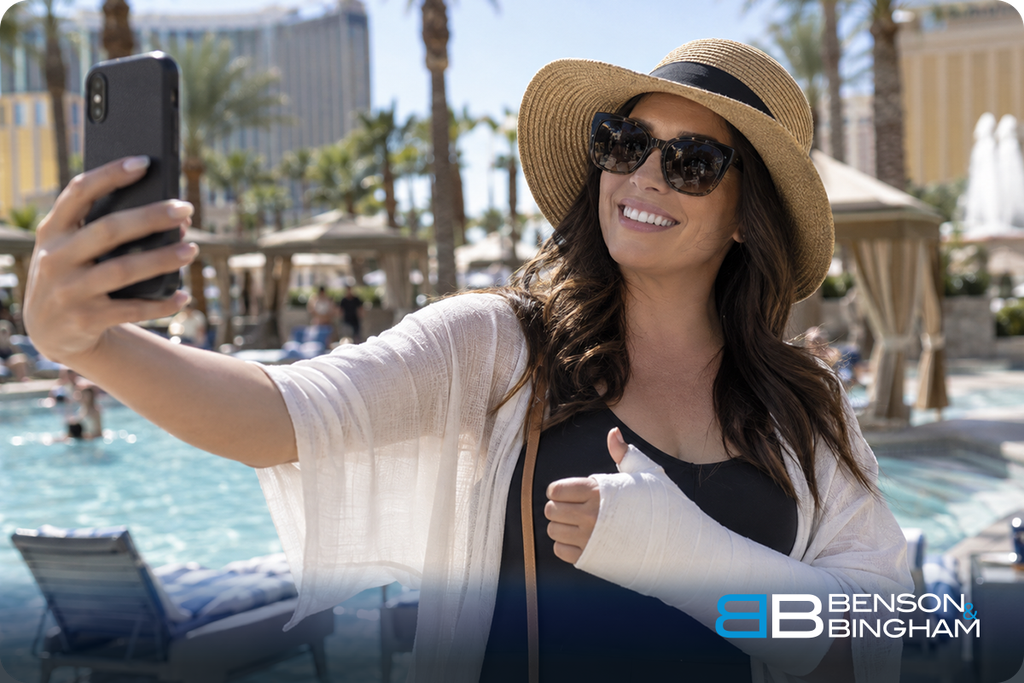
Posts That May Raise Questions About Your Claim
A few types of content deserve particular care:
- Smiling photos and nights out. People in pain still smile, attend dinners, and spend time with family. Even so, a post may prompt questions about symptoms or how the injury has affected daily life.
- Physical activity. Dancing, hiking, carrying luggage, lifting a child, or playing golf may be compared with your reported limitations. A photo rarely shows how long an activity lasted, whether you needed help, or what discomfort followed.
- Check-ins and timelines. Location tags and posting dates may be used to reconstruct your activities. The date a photo was uploaded is not necessarily the date it was taken.
- Comments and captions. An offhand “feeling great!” or “best trip ever” may be read as a statement about your health or physical condition rather than a moment with friends.
- Other people’s posts. A friend’s photos, tags, or videos can raise the same questions as something you posted yourself.
Do Not Delete Posts to “Fix” the Problem
Once litigation is reasonably anticipated, relevant digital information may need to be preserved, even before a lawsuit is filed. Deleting or changing photos can create a spoliation issue, meaning the loss or destruction of evidence that should have been kept or preserved.
Under Nevada’s rules, the consequences of lost electronic evidence depends on the circumstances, including whether it can be recovered, prejudice to the other party, and intent. Sanctions are possible, but not automatic.
Do not delete or edit relevant posts, messages, photographs, or accounts without first discussing preservation with your attorney. The same caution applies to disappearing messages and automatic deletion settings. Do not ask friends to remove existing material about you as a workaround.
A concerning post is something to review and explain. Trying to erase it can make the situation harder and more complicated. So, the right move is not to scrub what is there. It is to stop adding to it, and to lock things down going forward.
What to Do While Your Claim Is Pending
- Pause new posts about the accident, injuries, treatment, trip, and physical activities. Keep medical updates and claim discussions off social media entirely.
- Preserve relevant originals. Keep photos, videos, captions, comments, and messages, including material that may need explanation. Ask your attorney how to preserve temporary stories, reels, and other content that may disappear from publication.
- Review privacy settings with your attorney. Limiting public visibility may reduce casual access, but it does not remove legal preservation or disclosure obligations.
- Ask friends and family not to create new posts or tags about your injury or activities. Ask them to preserve existing relevant material rather than delete it.
- Do not delete or edit existing relevant posts without your lawyer’s guidance.
- Be cautious with unfamiliar connection requests. You do not need to accept requests from people you do not recognize. This can be potentially exploited.
- Tell your attorney about a concerning post early. Share the full context privately instead of trying to correct the record through another public post.
Are Private Accounts and Group Chats Protected?
A private account is not automatically protected from discovery. Relevant, nonprivileged posts or messages may have to be disclosed even when only friends or a small group could originally see them.
That does not mean the defense is automatically entitled to your entire account. Discovery is subject to relevance, proportionality, and other legal protections. Your attorney can best assess requests and seek the appropriate limits.
Do not assume that a group chat or direct message is protected simply because it is private.
Why Vacation Posts Deserve Extra Attention
A visitor’s injury may occur during a trip already being documented in detail. You may have a photo-rich record of where you went and what you did before, during, and after the accident online before you ever consider making a claim.
That record may contain useful evidence as well as material that needs context. Preserve it all and let your attorney know what exists. The same care applies to recorded statements: an early description may not capture everything you learn later about an injury. See: Should You Give a Recorded Statement After a Las Vegas Injury?
Posts about the accident may also be relevant to a dispute about how it happened. For how shared fault can affect negligence claims, see Nevada Comparative Negligence.
What We Have Seen in Our Clients’ Cases
At Benson & Bingham Injury Law, we have seen firsthand how seemingly innocent social media posts can become contested evidence for insurance companies and defense attorneys to use.
Drink Photographs Before a Fall
In one case involving a vacationer injured in a trip and fall, the defense found a collage showing our client with four different alcoholic drinks earlier that evening, before the accident.
There was no blood alcohol testing or other sufficient evidence establishing intoxication at the time of the fall, but the defense tried to use these photos to suggest alcohol impairment contributed to it. We challenged the proposed intoxication argument through pretrial motions and succeeded in preventing the defense from arguing that our client was intoxicated and contributorily negligent. The photographs themselves, however, were admitted into evidence.
That distinction matters: restricting a particular argument does not necessarily keep the underlying images out of the courtroom. A photo with a drink also does not, by itself, establish how much someone consumed or whether alcohol contributed to a fall or other injury.
A Vacation Flight After a Back Injury
In another case, our client had a serious back injury, was a candidate for surgery, and reported difficulty sitting longer than 30 minutes without significant discomfort.
About six months after the accident, he traveled from New York to California for a vacation and posted photographs of the trip on social media. At his deposition, the defense asked how he got there. His answer—a flight of roughly five and a half hours—became a way for the defense to question his reported sitting limitations.
Taking a flight does not establish that someone sat comfortably or without interruption throughout it. But the posts prompted questions about how the travel fit with his account of the injury and gave the defense an opening to pursue new lines of questioning.
Past results do not guarantee, warrant, or predict the outcomes of future cases.
A Post Is Not the Whole Story—And Does Not Automatically End Your Claim
Life does not stop after an accident. Injured people still attend family gatherings, travel, and try to enjoy planned activities despite pain and limitations.
A careful review looks beyond a cropped image or a single caption: when was the photo taken, what did the activity involve, and how does it fit with the medical records and your actual experience? Depending on the case, we can seek out context, challenge misleading interpretations, and address whether certain material should be admitted.
If you have already posted, do not assume you have ruined your claim. Preserve all of the material and discuss it honestly with your attorney. An early review is more useful than discovering the issue for the first time at a deposition.
Questions About a Post After Your Las Vegas Injury?
Call Benson & Bingham Injury Law at (702) 382-9797 for a free consultation. We are available to assist you 24/7. If you have returned home, ask about a free phone or video consultation with one of our attorneys.
Tell us what happened and whether there are photos, posts, or messages you are concerned about. We can discuss potential next steps and how to preserve relevant material.
With more than 25 years fighting for injured clients throughout Las Vegas, we know the tactics the defense may use, and we work aggressively to counter misleading evidence and unfair representations of our clients.
We strongly advise our clients to use extreme caution on social media during a pending claim, to avoid posting anything that could be misinterpreted, and to never delete or alter existing posts without first consulting their attorney. A single photograph may tell only a small part of the story, but in the hands of a skilled defense attorney it can become a significant issue in a personal injury case.
Call (702) 382-9797 | Request a Free Consultation
If you were injured on a Las Vegas trip and wish to review the full picture of how a visitor’s claim works, see Injured While Visiting Las Vegas: What Out-of-State Visitors Need to Know.