






There is a recording of your fall. There is a very good chance of that. Casino and resort properties in this city run some of the densest camera coverage of any commercial space in the country, and most public areas are watched from more than one angle.
Here is the harder truth: that recording is on a clock, and the clock is running right now. Every property is different, but in our experience most hotels and casinos do not keep their surveillance footage longer than about thirty days before the system records over it. Not out of any bad intent, that is simply how the equipment is built to work. It captures, it fills up, and it writes over the oldest footage to make room for the newest.
The video that would prove exactly what happened to you is, at this moment, the best evidence in your case. In thirty days, it may be gone forever, and no lawyer can recover it after that. This is the single most important thing for an injured visitor to understand, and it is the reason this page exists.
The Catch: They Only Have to Keep It if They Know
Property owners do have an obligation to preserve video footage and to document the area where someone slipped or tripped and fell. But that obligation turns on a condition that a lot of visitors never satisfy. The business must be placed on notice, either actual notice or constructive notice, that an incident occurred.
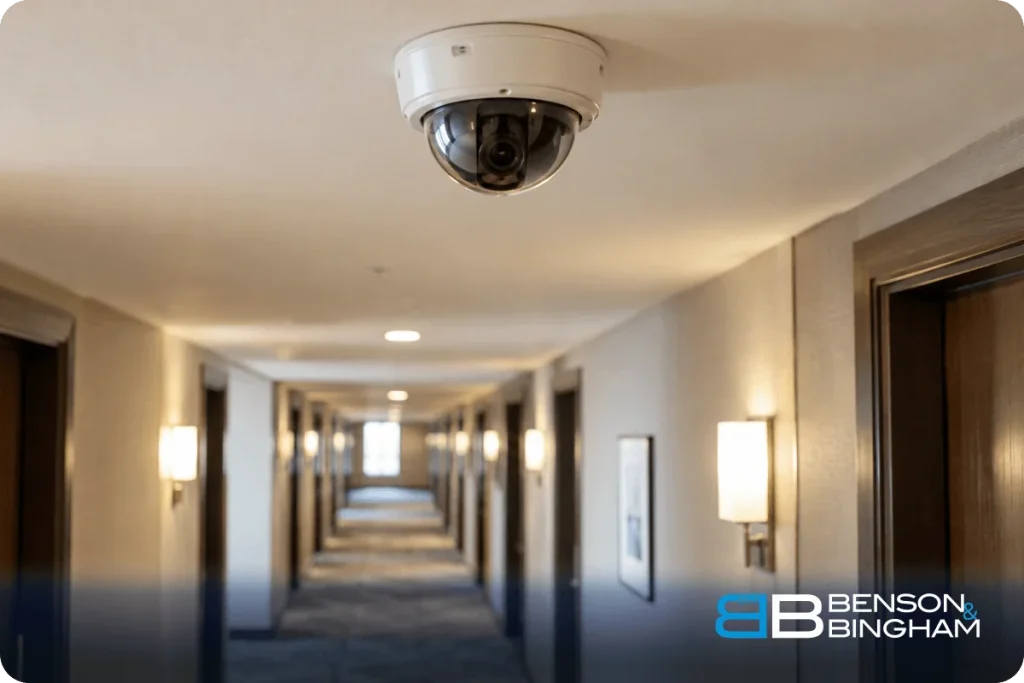
That is why filing an incident report with the property is an absolute must and not just a formality. It is the thing that flips a switch. Before the report, the footage of your fall is just one more clip in a system that will overwrite it on schedule. Once the report is made, the property is on notice, and its duty to preserve that evidence—and the potential consequences of failing to do so—become significantly more serious.
If you did not file a report at the time, that is a reason to move quickly, not a reason to give up. But it does raise the stakes on everything below.
The Out-Of-State Trap
We have seen this exact sequence more times than we can count, and it almost always involves someone from out of state.
You are walking through a lobby, across a casino floor, or into a bathroom when suddenly you slip and fall—a slick patch of liquid, a folded edge of carpet, or an uneven transition where the carpet meets the tile can send you to the ground without warning. You hit the ground. You are startled, and more than anything you are embarrassed. So you do what almost everyone does: you get up fast, brush yourself off, and try to carry on with your day or your night. You do not photograph the liquid. You do not photograph the carpet. You are not thinking about a lawsuit; you are thinking about the strangers who just watched you fall.
Then you fly home. A few days later something is not right, so you see a doctor, and it turns out this was not a sprain or a strain. It is a torn ligament, and it needs surgery.
Now you call a lawyer. But by the time you reach our office, weeks have passed. The spill has long since been mopped. The carpet has been repaired or replaced. The footage has cycled off the system. And your case has quietly turned into your word against the hotel’s.
Why “Your Word” Loses Without Evidence
That is not a fair fight, and it is worth understanding why.
When the physical evidence is gone, the property has a practiced set of responses. A million people walk through our lobby every month, they will say, and nobody else fell, only you. It is a powerful argument in front of a jury, and it works because of something jurors bring into the room before they hear a single fact.
People have a deep, almost reflexive bias about falls. When they hear that someone fell, their first private thought is often that the person should have been more careful or should have been watching where they were going. You are fighting that assumption from the moment you walk in. Photographs and video can overcome it. They shift the story from “you weren’t looking” to “look at what they left on the floor.” Without that evidence, you are at a significant disadvantage when it comes to proving liability, no matter how serious your injuries may be.
What Evidence Can Do When It Survives
The flip side is just as true, and it is worth telling you about a case that shows it.
We represented the family of a person who died after encountering a violation of the Americans with Disabilities Act on a property. What made that case winnable was a single decision by a family member in the immediate aftermath: they had the presence of mind to photograph the condition, even though they were not sure at the time that what they were looking at was a violation at all. They just took the pictures.
For a full year, before the family ever came to us, they were told the room had been inspected and that there was nothing wrong with it, no violation of any kind. Twelve months after the incident, the family retained Benson & Bingham. We immediately sent ADA experts, engineers, and building-code specialists to the location. They measured the scene and documented what they found: multiple violations of the Americans with Disabilities Act. Once those reports were produced, the defendant, which had spent a year denying any wrongdoing or liability, admitted the violations.
That case turned on evidence that survived because someone captured it early, as well as the ability to bring the right experts to the scene to explain what it meant. Video is one form of evidence that may disappear on a set schedule. Photographs are another—and when they exist, they can help carry a case even a year later.
What This Means for You, Today
If you were hurt on a Las Vegas property in the last few weeks, the clock on that footage is the most time-sensitive thing in your case. A few concrete steps matter more than anything else:
- Report the incident to the hotel if you have not already, and get the report number and the name of the person who took it. This is what puts the property on notice.
- Photograph everything you still can — and if you are reading this from a hotel room, that may still include the scene. A companion guide on exactly what to photograph walks through it.
- Get a preservation demand to the property before the retention cycle turns over. This is the step that stops the footage from disappearing, and it is the one an out-of-state person cannot realistically do alone. When our firm is retained, we can often get a formal evidence-preservation letter out within twenty-four hours, directing the property to suspend any routine overwriting or destruction and to preserve the video, the maintenance and inspection records, and the rest of what your case will depend on.

The reason a local firm matters here is not marketing. It is that someone has to be able to act inside the thirty-day window, to get a letter to the right department and, where it matters, to get people to the scene while there is still something to document. A firm that is not in Nevada cannot do that on the timeline this requires.
If your injury is recent, the most useful thing you can do today is start that preservation process. If it happened longer ago, the question becomes what still survives on the longer-retention records and that is worth finding out quickly, before more of it is gone.
To learn how the rest of a visitor’s claim works, start with our overview: Injured While Visiting Las Vegas: What Out-of-State Visitors Need to Know.