






The Las Vegas pool scene is its own attraction—dayclubs with DJs and crowds, resort pools built for lounging and cabana service, spas, and water features running all day. It is also a genuinely hazardous environment: wet decks, dense crowds, alcohol, glass, sun, and pool chemistry, all in one place. When someone is seriously hurt at a pool or day club, the injury is only half the problem. The other half is a question most visitors never see coming: who actually runs this place, and who do you hold responsible?
Benson & Bingham represents people injured at Las Vegas pools, dayclubs, and spas. This is what these cases involve and why they are rarely as simple as they look.
How People Get Hurt at Pools and Dayclubs
The settings vary, but the injuries cluster into a few patterns:
- Slip-and-falls on wet decks—the most common by far, on surfaces that were never made slip-resistant or were allowed to become slick.
- Diving and shallow-water injuries—catastrophic spinal and head injuries, often where depth was poorly marked or a guest misjudged a pool built for wading, not diving.
- Drownings and near-drownings—especially where supervision, fencing, or lifesaving equipment fell short.
- Drain and suction entrapment—powerful pool and spa drains can trap a hand, foot, or hair and have caused severe injuries, particularly to children.
- Chemical burns and respiratory injury—from chlorine and other pool chemicals that are mishandled or allowed to reach unsafe levels.
- Glass injuries, crowd and overcrowding incidents, and alcohol-related falls—the dayclub environment specifically, where crowds, drinking, and hard surfaces combine.
- Assaults and security incidents—covered further in our article on nightclub and bar injuries.
The Wet Deck—and Safety Codes Often Overlooked
Because water on a hard surface is unavoidable at a pool, the surface itself is supposed to be built for it, and in Clark County that is not left to chance. The county and the Southern Nevada Health District enforce specific construction standards for the areas around commercial pools and spas. The walking surfaces, decks, ramps, and coping within four feet of the water must be built of slip-resistant, cleanable materials; adopted codes call for wet walkways to meet a minimum dynamic coefficient of friction of 0.42 under ANSI A326.3 (or an equivalent pendulum rating); and deck surfaces must slope one to two percent away from the pool so that water drains rather than pools. The pool’s interior finish, too, must be smooth and non-absorbent, with rounded, coved corners rather than sharp edges.
Those requirements matter more than they sound, because pools are governed by a web of city, county, and state codes—and in Nevada, violating a safety code like this can establish a presumption that the property was negligent, rather than leaving you to prove it from scratch. Many Las Vegas properties do not realize their decks fall short of the standard. A deck that fails it can turn a “you should have watched your step” defense into a documented code violation.
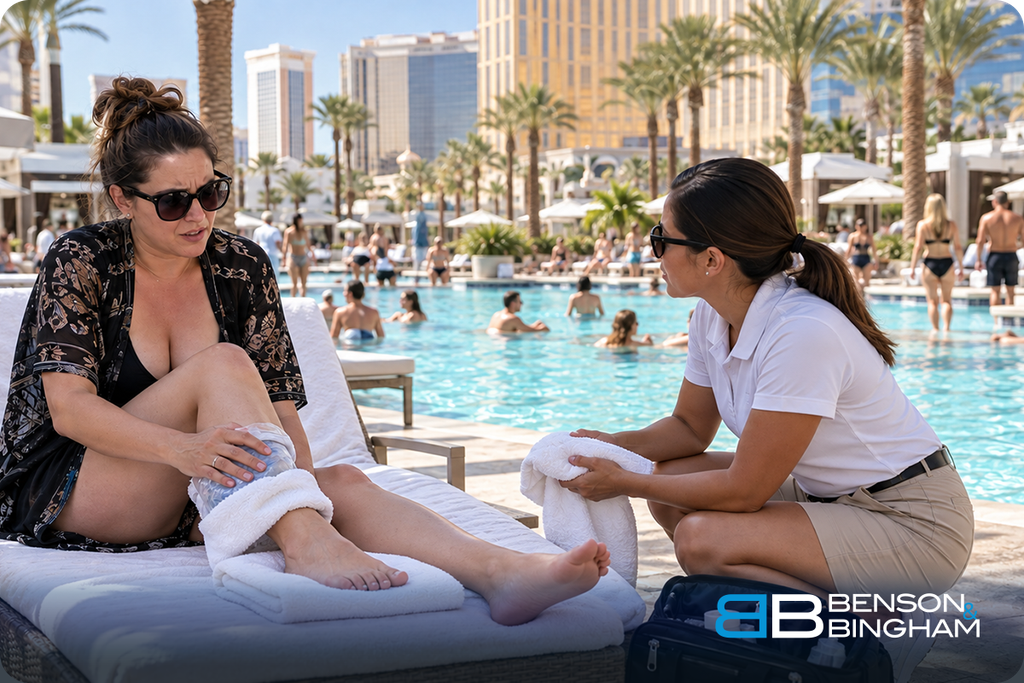
The Hazards the Codes Are Built Around
Pool codes exist because these dangers are predictable, and each is a place a property can fall short:
- Fencing, depth markings, and lighting. Codes generally require secure fencing or a lifeguard, clearly marked depths, and lighting that illuminates the entire pool.
- Drain and suction covers. Pool and spa drains must use anti-entrapment covers; older systems were required to be retrofitted, and a missing or broken cover is a serious hazard.
- Chemical safety. Chlorine and bromine keep pool and spa water safe, but in the wrong concentration they burn skin and airways, a particular risk in hot spas, where warm water and heavy use push chemical demand up.
Who Is Actually Responsible?
This is where pool and dayclub cases get complicated, and it is the single most important thing to get right. The pool or dayclub where you were hurt may be run by the hotel itself, or it may be operated by a separate hospitality or nightlife company under agreement with the property, with its own staff, its own insurance, and its own liability. The name on the entrance is not always the entity responsible for the injury.
Naming the wrong party, or missing one, can cost you. Sorting out who owns and who operates the venue is early, essential work, and it is covered further in our article on who actually owns the hotel where you were hurt.
In our experience, this is the question that decides who actually pays. Many of the biggest Las Vegas pool venues are not run by the hotel whose name is on the building, they are operated by separate nightlife and hospitality companies, each with its own staff, its own policies, and its own insurance. A dayclub operator cannot hide from liability behind the hotel property, and pinning down the correct operator is what makes a claim work. Over our 27 years, we have identified and filed claims against every currently existing Las Vegas dayclub, so we know this landscape well.
Here is how the major Las Vegas dayclubs and pool venues line up as of 2026, the property each sits on, and the company that actually operates it:
| Dayclub / Pool Venue | Property | Operator / Management |
| Encore Beach Club | Wynn / Encore | Wynn Nightlife |
| Palm Tree Beach Club | MGM Grand | TAO Group Hospitality (with Palm Tree Crew) |
| TAO Beach | The Venetian | TAO Group Hospitality |
| Marquee Dayclub | The Cosmopolitan | TAO Group Hospitality |
| LIQUID Pool Lounge | ARIA | TAO Group Hospitality |
| OMNIA Dayclub & Skybar | Caesars Palace | TAO Group Hospitality |
| AYU Dayclub | Resorts World | Zouk Group |
| LIV Beach | Fontainebleau | Groot Hospitality |
| Tailgate Beach Club | Mandalay Bay | MGM Resorts |
| Stadium Swim | Circa | Circa (Stevens ownership group) |
| AZILO Ultra Pool | SAHARA | SAHARA Las Vegas / Meruelo Group |
| Drai’s Beachclub | The Cromwell | Drai’s Management Group |
| Moorea Beach Club | Mandalay Bay | MGM Resorts International |
Because these operating relationships shift as venues rebrand and management companies change, the defendant in your case depends on who ran the venue on the day you were hurt, one of the first things we establish.
What About the Drinking?
Pools and dayclubs run on alcohol, which raises two questions people worry about. The first: can the venue be blamed for overserving? In Nevada, generally no, unlike many states, Nevada does not impose dram-shop liability, so a claim is not built on the fact that a venue served or overserved a patron. Instead, it turns on the venue’s own failures: an unsafe deck, inadequate security, overcrowding, poor supervision, or a hazard it ignored.
The second: I had been drinking. Is the accident my fault? Not necessarily, and it does not automatically end a claim. How your own conduct factors in is its own subject, which we cover in our overview for out-of-state visitors.
The Out-Of-State Problem
A dayclub on a busy afternoon is a chaotic, crowded place, and for a visitor that creates the same evidence problem that runs through every Las Vegas injury: you fly home, and the proof stays behind. Surveillance, incident reports, staffing and maintenance records, pool-chemistry logs, and the records of whichever company actually operated the venue all sit with the property or the operator and only survive if someone demands their preservation before they are gone. That is work a local firm can begin immediately.
For the full picture of how a visitor’s claim works, start with our overview: Injured While Visiting Las Vegas: What Out-of-State Visitors Need to Know.